EXPRESS Singing Blog · Podcast
Acting for Singers: How to Connect With a Character on Stage
River Guard is an operatic tenor, singer-songwriter, composer, actor and multi-instrumentalist from Hamilton, Ontario. He holds a master’s degree in opera from the University of Toronto, received the Rebanks Family Fellowship at the Royal Conservatory’s Glenn Gould School, shared Third Prize at the Canadian Opera Company’s Centre Stage competition in 2022, and was a Detroit Opera Resident Artist in 2023–24 and 2024–25. His roles include Lensky in Eugene Onegin, Don Ottavio in Don Giovanni and Miles in Proving Up. In this episode of the Singers Tension Podcast, he talks with host Jordanne Erichsen, soprano and founder of EXPRESS Voice Studio, where working artists teach private singing lessons in Toronto, Montreal and Vancouver. The two met at Opera NUOVA in Edmonton, in a production of Eugene Onegin.
The short answer: acting for singers is less about adding something on top of the voice and more about allowing yourself to be a real person in front of an audience. Know your own habits and reactions, do the homework on your character, then trust your instincts and stop monitoring your sound while you perform. Read this guide, or press play to hear the whole conversation.
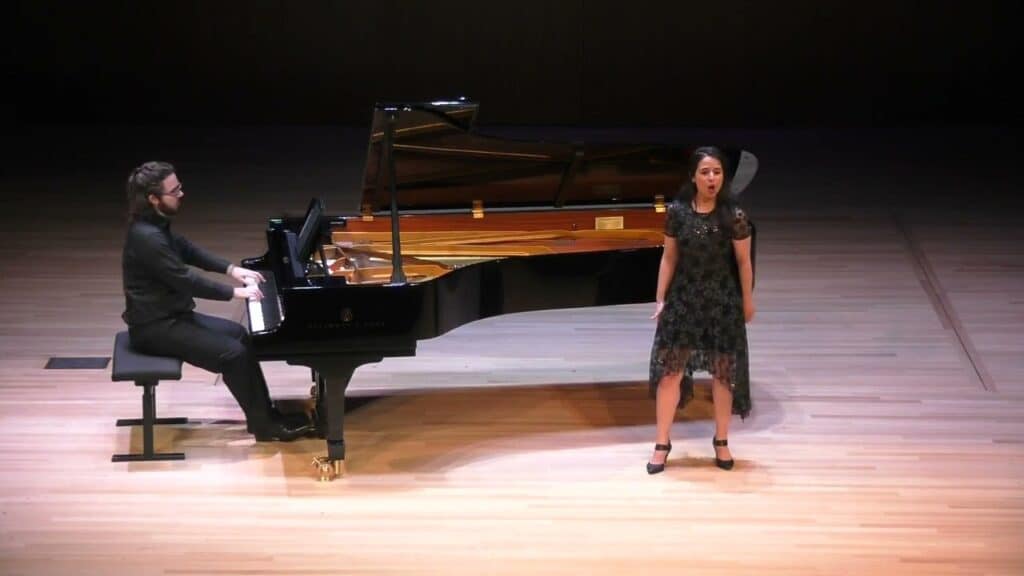
To see River perform an aria from Gounod’s Faust at the Canadian Opera Company’s Centre Stage competition, check out his Instagram post below!
See River Guard’s post on Instagram

Want to tell the story as well as you sing it? Book a lesson with an EXPRESS coach, in person or online.
How This Article Was Written
This article was conceptualized with the help of AI and built from the transcript of Singers Tension Podcast Season 1, Episode 5, recorded in 2020. It is written and reviewed by the EXPRESS team. Quotes are lightly edited for readability. One short personal passage of the conversation is not covered here, and the transcript at the bottom of this page leaves it out; the complete conversation is in the episode itself.
Table of Contents
Article Takeaways
Acting is not something you add to singing. It is allowing yourself to be a real person while you sing.
Do the character homework in the practice room, then leave it at the door and trust your instincts on stage.
At a certain level everyone sings well. What sets performers apart is the freedom to let go and live the story.
Acting for Singers Starts With Being Yourself
Jordanne invited River onto the podcast because of what she saw at Opera NUOVA, a young artist program in Edmonton. Whether he was singing opera or musical theatre, she was on the edge of her seat, and at times moved to tears. Her first question is the one many singers want to ask a performer like that: has it always been easy?
River grew up in a family that works in theatre, some as actors and some as technicians, so he was surrounded by people who respected the craft of communicating in front of others. He loved getting up in front of people and being a clown. He is careful to say that this doesn’t mean acting just happens without thought. The basis of his technique, as he describes it, is allowing himself to be the human that he is, and finding the sensitivity to show that in front of other people. He calls that the hardest part of the craft for most performers.
Stage fright never fully goes away
Asked whether he ever felt self-conscious about being vulnerable, River says he feels that way every time he does anything, including the podcast interview itself. Getting from being the person who is about to perform to being the person who is performing is still daunting. He adds that he has always been more afraid of his own internal critic than of the real critics, because he is the one who has to be content with the work he did.
What gets him past the fear is the reason he stepped on stage in the first place: “I have something to say.” He loves communicating and talking to people, and that pull is stronger than the nerves.
- Expect nerves, even after years of performing
- Notice whether you fear the audience or your own inner critic
- Before you walk on, remind yourself what you want to say
- Let yourself look foolish in rehearsal; it builds openness
For more on what it means to express yourself without fear of judgement, check out this post from the EXPRESS Instagram below!
See the EXPRESS reel on expression on Instagram
Know Yourself Before You Play Someone Else
Jordanne asks whether acting means being self-reflective all the time, so that you can dissect your own choices and apply them to a character. River agrees, with one condition. He pushes himself to be as aware as he can of his own habits: why he gets up a certain way in the morning, why he responds a certain way to a comment or a tone of voice. That awareness belongs to everyday life and to preparation. In performance, he says, you have to take your hands off the wheel, or you get stuck in a place that is too analytical.
Knowing your own patterns is what lets you step outside them when a character behaves differently than you would. You can see where you and the character intersect and where you don’t, and River finds there are usually more points of connection than you expect. The character then becomes more yourself. He doesn’t think “he is doing this.” He thinks “I am doing this”: my Nemorino, my George. The performer, as the complete person they are that day, goes through the narrative the librettist and composer set down on the page.
River remembers Jordanne doing exactly this kind of work when she sang Tatiana in Eugene Onegin. She was always buried in a notebook where she had written out Tatiana’s inner life, including events she built from the Pushkin novel that sit outside the opera.
The everyday-life exercise
Jordanne describes a university acting class taught by a teacher who had studied in person with Uta Hagen in New York. The class worked through Hagen’s book, and one exercise was to recreate a scene from your everyday life in front of everyone. Some students made soup. Jordanne recreated coming home after a long night of waitressing and counting her tips. The goal was to get used to being yourself authentically, with all your real intentions, while being watched. Later you approach a character the same way: a normal person making choices, an extension of you who chooses differently. River admits he finds the exercise incredibly difficult, because being observed changes everything.
- Write down what you do when you are tired, excited or annoyed
- Recreate two minutes of your own evening for a friend or a camera
- List what you share with your character, then what you don’t
- Say “I” when you talk about your character’s choices
- Keep a notebook on the character’s life outside the score
The Best Acting Advice: Trust Your Instincts
When Jordanne asks for the best acting advice he has ever received, River says it didn’t come from a teacher or a book. It popped into his head before a performance, and he now repeats it to himself before every reading, voice-over session or monologue: “trust your instincts.”
He explains why singers need to hear it. After years in a music or theatre program, it is easy to believe you don’t know how to do the thing you went to school for, since you went there to learn to do it better. Many performers, River included, make the mistake of forgetting that they already know how to sing a tune and say words to people off a piece of paper. With Shakespeare and with opera there is extra pressure to be poised and larger than life. He finds that silly, because in his words opera and theatre are “just the reflection of life,” a mirror or a pane of glass we look at life through. The actor’s job is to synthesize human experience as authentically as possible.
Do the homework, then let go
River is clear that instinct is not a replacement for preparation. Acting is a craft and a technique in the same way that singing is. You learn the universe of the piece, the details, and what every single word means, especially in classic texts where the meaning is wrapped in poetic language. Then you sit within yourself and let instinct guide the sentence you are saying. Before he starts, he tells himself: remember that you know how to do this, you’re just talking.
Jordanne adds the teacher’s view. Acting tools such as transference and choosing a verb for each line can be taught. An actor’s instincts cannot be replicated by anyone else, and accepting that is a big hurdle for people who are new to acting.
- Look up every word of your text, including the translation
- Know your character’s world before the first rehearsal
- Speak the lyrics as if you were simply talking to someone
- Just before you begin, tell yourself “trust your instincts”
For more ways to feel confident when you step on stage, check out the video below!
Stop Chasing the Perfect Sound
For a long time River assumed that few people in opera cared about communicating with the whole body, because so much of the work in school is based on perfecting vocal function. Watching videos of Maria Callas from the 1950s and 60s changed his mind and renewed his hope for opera as a singing and acting art form. She was so instinctive, he says, and while the voice was not perfect, “there is no perfect voice.” There is no perfect acting technique either. What performers do is subjective. Some things connect with an audience and some don’t.
Jordanne describes the same idea from the singer’s side. You can spend years and a great deal of money making your instrument able to sing show after show in musical theatre, or to project across a large hall in opera. Once your teachers tell you that you are singing well and it feels strong and comfortable in your body, the voice has to become a tool for telling the story. There will be moments when you check in before a hard passage. Then you let the thought go and carry on being alive as the character. River makes a similar point about singing: if you listen to yourself while you sing, you interfere with the next sound that is about to come out.
Learn from the singers beside you
River gets as much inspiration from classmates and colleagues as from famous artists on YouTube. He looks at what his friends do well that he hasn’t mastered yet, and he enjoys cheering them on. Jordanne talks about the pressure in opera and musical theatre to be the best right now and to treat everyone as competition. She made a point of breaking that habit by asking colleagues in bigger roles how they approach high notes or what they are thinking in a scene.
- Watch great singing actors and notice what they do with their bodies
- Ask a colleague how they approach a passage or a scene
- Plan one technical check-in per difficult phrase, then drop it
- Record a run-through where your only goal is telling the story
To release habitual tension before you sing, so your body is free to respond in the moment, check out the video below!
When Your Voice Program Doesn’t Teach Acting
Jordanne raises the imbalance she sees in many university programs, where the voice gets far more emphasis than acting and singers can graduate without any straight stage acting experience. River recognizes it. Until he was 17 or 18 his musical life was writing his own music, playing in a rock band and acting in plays and musicals. Then he entered classical training, where it is easy to believe that perfecting the voice is the end goal and the only thing worth worrying about.
The result, as he has observed it, is singers who stay in the technical side of the brain on stage, consciously deciding every fork in the road. Students are flooded with information and contrasting opinions, and their own instincts go quiet. He remembers many performances where he was gripped by terror and not having fun, worried about what a teacher or coach would say afterward. He also questions whether an academic model is the best way to foster young artists. His point about the profession is direct: at a certain level everyone sings beautifully, knows their technique, the languages and the source material. What sets people apart is the ability to do all the work and then let go, to become a conduit for the narrative. Learning to perform, he says, is not like learning math: “it’s just kind of learning how to be a human being.”
How to build acting skills on your own
Jordanne offers practical steps for singers whose program is light on acting. Work through the books of great acting teachers such as Uta Hagen. Look for acting opportunities outside school, such as an improv group or sessions with a good acting coach. Sit with yourself and keep a journal: on a day you felt low, write down how it showed up in you. That record of experience is what you draw on to reinforce your instincts. If you want guided practice, EXPRESS also offers private acting lessons alongside singing.
- Read one acting book this term and do the exercises
- Join an improv group or a community theatre production
- Book a session with an acting coach on a song you already sing well
- Journal how emotions show up in your body and behaviour
- Ask your voice teacher to spend part of a lesson on text and intention
Commit to Your Choices on Stage
Both of them come back to the same picture of a prepared performer. Jordanne describes knowing every intention in the show, then getting on stage with a scene partner and no longer thinking about the verb on each line. You have lived with the character for months: their world, their parents, what they love and hate. On stage it stops being technical words on paper and becomes a real person living and breathing, which is why a performance can feel like it passes in the blink of an eye. River says the same thing happens when he performs his own songs. When he has really told the story, he comes off stage and barely remembers it happening.
River compares self-awareness and journalling to a painter’s palette. Knowing what you have felt gives you a wide range of colours to draw from. In the end, he says, what matters is that you sing, act and communicate the way you want to, because audiences “can tell the difference” between a performer seeking outside validation and one who loves the art and has their hands off the wheel. Even when we disagree with a choice, it is better to watch someone who has committed to it and let us share in it.
Jordanne closes with the takeaway she wants every singer to hear. Once you have a technique that feels good and comfortable, give yourself permission to be a confident performer.
- Build a technique that feels comfortable and repeatable
- Do the character work early, so it is part of you by opening night
- On stage, think about what your character wants, not the next note
- Make a choice and commit to it fully
- Give yourself permission to be confident
To get your voice ready before your next rehearsal or performance, check out the video below!
Listen to the Full Episode
This guide is based on Season 1, Episode 5 of the Singers Tension Podcast, “Acting Development with River Guard,” released in December 2020. Prefer to listen? The full 30-minute conversation is below.
About River Guard
River Guard is a Canadian operatic tenor, singer-songwriter, composer, actor and multi-instrumentalist from Hamilton, Ontario. He holds a Bachelor of Music and an opera diploma from Wilfrid Laurier University and a master’s degree in opera from the University of Toronto, where he studied with Wendy Nielsen. He is an alumnus of the Aspen Music Festival and School, the Banff Centre’s Opera in the 21st Century program, Highlands Opera Studio and Opera NUOVA, and a recipient of the Rebanks Family Fellowship at the Glenn Gould School. He shared Third Prize at the Canadian Opera Company’s Centre Stage competition in 2022 and was a Resident Artist at Detroit Opera in 2023–24 and 2024–25. His roles include Lensky in Eugene Onegin, Don Ottavio in Don Giovanni, the Male Chorus in The Rape of Lucretia and Miles in Missy Mazzoli’s Proving Up.
About the host
Jordanne Erichsen is a soprano, vocal coach and Alexander Technique practitioner, and the founder of EXPRESS Voice Studio. She hosts the Singers Tension Podcast, where working singers talk about technique, the body, performance and the music industry. More episode guides: how to practice singing (even on bad days) with Susan Elizabeth Brown, is opera dying? with Andrew Adridge, opera vs. musical theatre with Alyssa Curto, how to sing jazz with Laura Anglade, how to become an opera singer with Lyndsay Promane and how to become a vocal coach with Jessica Kos-Whicher.
EXPRESS coaches like Jordanne teach private singing lessons in person in Montreal, Toronto, Vancouver, Ottawa and Mississauga, and through online singing lessons anywhere in Canada. Whether you sing opera, musical theatre or your own songs, a coach can help you build healthy technique and the confidence to tell the story.
Ready to explore your voice? Find your EXPRESS teacher, in Montreal, Toronto, Vancouver or online.
Frequently Asked Questions
How can singers improve their acting?
Start by knowing yourself. Notice your own habits and reactions, write them down, and look for where you and your character overlap. Then do the homework on the text and the character’s world, take an acting or improv class outside your voice lessons, and practise performing without monitoring every sound you make.
Do opera singers need to act?
Yes. An opera character is a real person living through something who also happens to be singing. Tenor River Guard says that once singers reach a certain level, nearly everyone sings beautifully, and what sets performers apart is the ability to let go and live the story in front of an audience.
What is the best acting advice for singers?
River Guard’s favourite advice is “trust your instincts.” Do the preparation, learn what every word means and know the world of the piece. Then, before you start, remind yourself that you already know how to communicate, and let instinct guide each sentence.
How do I stop thinking about technique while I perform?
Build a technique that feels good and reliable in the practice room, then treat your voice as a tool for telling the story. Allow yourself a quick check-in before a hard passage and then let it go. Listening to yourself while you sing gets in the way of the next sound.
How do I get over stage fright as a singer?
Stage fright rarely disappears, even for experienced performers. River Guard says he feels nervous every time he performs and is more afraid of his own inner critic than of real critics. What carries him through is remembering why he stepped on stage in the first place: he has something to say.
How can I learn acting if my music program doesn’t teach it?
Work through the books of great acting teachers such as Uta Hagen, join an improv group, take a class or work with an acting coach outside your program, and keep a journal of how your own emotions show up in your body and behaviour. That record becomes the material you draw on for characters.
Full Episode Transcript
This transcript of “Acting Development with River Guard” was generated automatically and lightly corrected, so small errors may remain. One short personal passage is not transcribed; the complete conversation is in the episode above.
Read the full transcript
Introducing River Guard (00:13)
Jordanne: This is the Singers Tension Podcast, the podcast by singers about singing for singers. This is part one of a two-part series with River Guard. Welcome to the Singers Tension Podcast. My name is Jordanne Erichsen and I’m here today with River Guard, an operatic tenor, a composer, multi-instrumentalist and actor. I first met River through Opera NUOVA, a young artist program in Edmonton for opera singers, and was highly impressed by his versatility as a singer and an actor. I remember always being on the edge of my seat, completely engaged with his performance, whether it was musical theatre or opera, and even at times being moved to tears.
For this reason, I knew that I wanted to have River on the podcast to talk about acting as a singer and the artist’s emotional connection to music. So welcome River to the podcast. You have what seems to be the gifted ability to connect emotionally with your character and to translate that to the audience in a genuine, authentic way that truly moves people. What is your background with acting? Have you always found it easy to develop a realistic, motivated character?
River: I find that for me, you know, I was really lucky to have a lot of support from my family and from my parents when I was young. I had a lot of support from my grandparents and from my extended family who also works in the, they all work in the theatrical kind of idiom, whether as actors or as technicians. So I kind of grew up in a family and a universe that really respected the craft of just kind of communicating as humans in front of other people. So I just always kind of knew that it was something that I really, really wanted to do with my life.
I loved getting up in front of people and making a complete fool of myself and just being a clown and just kind of trying to dig within myself to find any sort of sensitivity and ability to show that sensitivity in front of other people, which is, I think, for a lot of us, the hardest part of the craft of acting.
But it’s always felt like something that I could just kind of wake up in the morning and if I just allowed myself to be myself, it would come out more or less the way that I wanted it to, which can sound like something that you know, makes me sound like it’s just something that happens and I don’t think about it, which is, of course, not true. But for me, I really believe that the basis of my technique and my inspiration is acting is really just allowing myself to be the human that I am.
Vulnerability and stage fright (03:10)
Jordanne: Did you ever have moments or at the beginning of your journey of acting and performing where you felt self-conscious about being vulnerable?
River: Oh, yeah. Oh my gosh. I mean, and the thing is that I feel that way every time I do anything.
Even for what I just said, where it feels relatively easy for me to slip into the skin of just being open and vulnerable in front of people, it still is incredibly daunting to just get your feet to step out in front of in front of the audience and and get yourself from Being the person who’s about to perform to being the person who is performing and I guess it changes for everyone’s levels of anxiety and and Stage fright but for me, I’ve I’ve always been intensely fearful just because I think You know like any artist we start holding ourselves to an internal standard that that is is almost disconnected from from the audience members or from our colleagues or from what we’re worried about, what other people say, I find that I’ve always been more fearful of my own internal critic than the real critic, the people who are writing things about me.
Because at the end of the day, I’m the one who has to go to sleep with myself and I have to be content with what I did, with the work I did. How I allowed myself to be. And so I do get quite fearful. I’m nervous even now just being interviewed on a podcast. But there’s always just the thing that keeps us going through that fear. And the reason why I picked up the phone in the first place, the reason I stepped on stage in the first place, is that I have something to say. And I just love communicating. I love talking to people.
Self-reflection and building a character (04:55)
Jordanne: So do you feel like one of the most important parts of acting is to be highly self-reflective all the time and analytical about the personal choices that you make so that you can dissect them and apply that to a character saying okay this is how I behave as a human so therefore this human maybe would make the same choice or different choice based off who you are.
River: Yeah no for sure I mean and I remember too because we met doing Eugene Onegin at Opera NUOVA in Edmonton and I remember too when you were singing Tatiana and how you would always be so engrossed in your notebook that where you had written so much of what you felt that Tatiana’s inner kind of neuroses was like how her mind was dealing with the issues that went on in the opera and then in the events that I feel like you built and and took from the Pushkin novel outside, which is something I think that, you know, it’s an exercise in self-reflectivity.
I think that for me, I’ve always really pushed myself to be as self-aware as I can in terms of my own habits, my own neuroses, the things that make me make choices every day, the reason why I get up a certain way in the morning or I respond a certain way to a certain kind of comment or tone. I feel that as an actor, so much of it can be quite instinctive, but if you don’t kind of take your hands off the wheel when you’re doing it, then you can kind of get stuck in the too analytical, the too reflective in the moment. And it’s the same thing with singing.
If you’re listening to yourself, while you’re singing, you’re kind of messing up the next sound that’s about to come out.
[A short personal passage is left out here. The complete conversation is in the episode above.]
I really feel that it’s important for an actor to be aware of what we do so then when a character needs to do something else, when a character doesn’t really adhere to how we are naturally, then we can kind of step out of that box. And we can see where we intersect with the character, what things we have in common with the character, and what things we don’t. And then you can find the commonality, and you can find more ways than not that you actually do relate to the character.
And in that way, then, the character becomes more yourself, as opposed to the actor thinking, oh, he or her is doing this, as opposed to, I feel at least the way I think about it. Like I am doing this, my Nemorino is doing this, my, you know, George is doing this.
I find that so much of it, because we are just simply allowing ourselves to experience the narrative of whether the opera, the music, the musical theatre, or even just like the song that you’re playing, we’re just allowing ourselves as ourselves, like the complete person you are in that moment that you step out on the stage, we are just allowing that version of yourself to go through the narrative that the librettist and the composer have set down on the page.
So being self-reflective I feel like is so important because then you’re able to know what you do normally that doesn’t line up with the character and you’re also able to just really find a sense of freedom within the boundaries of what the character needs to be doing.
The Uta Hagen everyday-life exercise (08:55)
Jordanne: Yeah, I remember working with this really brilliant acting teacher, Kelly Henderich, who is one of the last people to be able to study with Uta Hagen in person in New York. And so in this class in university, we were basically working through her book with his guidance. And one of the exercises is to recreate a scene from your everyday life. And live it in front of everyone. So some people recreated a scene where they were at home cooking soup for themselves. And I remember mine was getting home after a really long night of waitressing and like counting my money.
And the point was to recreate that evening with all your intentions and feelings and transferences so that you could just get used to being yourself authentically and understanding your own motivations. And then the idea is, later when you take a different character that’s not yourself you approach it the same way where this is just a normal person making choices and it’s not so far-fetched it’s just it’s not you anymore but it’s an extension of you making different choices than you would in your everyday life.
River: It’s so hard to do though right that that exercise just doing something that you do naturally what about all of a sudden being observed I find that so incredibly difficult.
Jordanne: It is difficult. And then you wonder, why do I talk to myself so much at home? You know, just talk to yourself for no reason. I remember that was a conversation in the class once where it was like, why did you talk to yourself in that moment? And I was like, I don’t know. I was really excited about the money I was making.
River: No, for sure. For sure.
The best acting advice: trust your instincts (10:35)
Jordanne: So what is the best acting advice you feel that you’ve ever received? It doesn’t even have to be from a person, perhaps you read it, but it really resonated with you.
River: You know, a lot of the advice you get, you know, there’s so many ways to approach this really, really seemingly simple thing that we do as communicators, as actors. But there’s so many ways, just like singing, to look at. And I found that, weirdly enough, my favorite advice that has helped me the most has been something that just kind of popped into my brain when I needed it. Before a performance, actually, that just is something that always just reminds me that I actually do know how to do this thing inherently.
We get so caught up in the kind of institutionalized, academic world, especially if you’re someone who has gone to an undergraduate or a master’s program in either theater or a voice or music or any sort of thing where you go and you learn from people who know what they’re doing. We get so caught up in the idea that we tell ourselves we don’t actually know how to do this thing that we went to school for, because obviously we’ve gone there to learn how to do it better.
But then I think a lot of people, including myself, we make the mistake to just kind of drop it all at the door and forget that inherently we know how to make music, we know how to sing a tune, we know how to say some words in front of people off of a piece of paper.
My favorite thing that I just kind of tell myself whenever I have to read something whether it’s for like voice work or or monologue or or any sort of thing is just trust your instincts which is so simple and it can be done to a kind of a fault where it doesn’t make sense anymore and it may not help but acting is a craft and a technique in the way that vocal vocalism is but I think that so much, at least for me, that has helped me is just allowing myself to just be, again, like what I said, be like the creature that I am in the moment, in front of people, because you can do so much prep work as a worker, as an actor, in terms of learning your universe and making sure that you know the details and making sure that you know what every single word means, especially if you’re doing Shakespeare or any sort of classics where the dialogue and everything that you’re saying is sort of covered in poetic lyricism, I find even then it’s really just important to sit within yourself and allow for an animalistic instinct to just guide the sentence you’re saying.
So for me, it really helps myself to just, before I start, just internally repeat to myself, trust your instincts. Remember that you know how to do this. You’re just talking. I think we think so much, especially with Shakespeare, you get caught up in this idea that it’s this big, grand, where we have to have English accents and we have to be so poised and we have to put in an opera is totally at fault for this as well, that we have to be something larger than life, which is so silly because opera and theater is just the reflection of life.
It’s just a mirror or a pane of glass that we look at life through. And as actors, I think our job really is just to synthesize our own experience, the human experience, as authentically as we can. I think every single human being, I say the same thing about making music as well and singing, every single human being knows how to do that inherently from when they’re born. All we have to do really is just allow that channel to be open and to communicate as like the instinctive actor that we already are.
Instincts, Callas and learning from colleagues (14:14)
Jordanne: Yeah, and that is a massive hurdle for most young actors or people that are starting to take acting seriously is accepting okay I don’t know everything that’s why I’m I’m learning or I’m new to this but that your your instincts are not teachable I can teach you how to do transference how to do verbing etc these are things I can teach but no one can replicate an actor’s instincts.
River: Yeah for sure there’s been so many different different ways that people have expressed themselves in in terms of in terms of performing, whether it’s an opera, you know, like I have a few favorite opera singers, like obviously you could talk about Callas in terms of, and like who I’ve been learning a lot about recently because my girlfriend is really, really a huge fan of her and I’d never really taken the time to listen and to watch her perform, but watching someone in the operatic idiom, really communicate the way that I wanted to be able to communicate for a long time and I didn’t and I assumed a lot of people in opera weren’t communicating because you know so much of our work especially in the school system is just so based on the perfection of the vocal function you know and so for a long time I was convinced that no one would really actually cared about They cared about communicating with their full body, with the idea of a character in mind, with the idea of making it real, the idea that the character is just a real human being living through something, who also happens to be singing.
So now watching videos of Callas in the 60s and in the 50s singing, it definitely has reinvigorated my hope for what the operatic art form can be in terms of it being a singing acting art form because she’s just so instinctive that the technique is there obviously it’s not like a perfect voice but what is a perfect voice there is there is no perfect voice there is no perfect acting technique like the thing that we do is inherently subjective there’s no objective real like cream of the crop, I believe. I think there’s just the things that connect with us and the things that don’t.
The things that the mark lands and the things that don’t. And that is, for me, I mean, there have been so many wonderful, you know, inspiration-fueled people that I’ve really fell in love with and loved watching perform.
But, you know, I find that really trying your best to look at, you know, the colleagues in your class Looking at the people that you’re seeing like in person not always like the people that you’re watching on YouTube Really looking at the people and seeing what they do really well, you know I look at my friends my close friends and all the people that I sing with and I’m always just in awe of something or other that they do that I just haven’t quite mastered yet and that’s always super exciting and inspiring to me because then it’s just it’s so wonderful for one to see your friends doing well, I I get so much inspiration from just like cheering my friends on because I think everyone is so talented you know and everyone everyone can do something that that you can and I think that should be celebrated.
Voice versus acting in university programs (17:25)
Jordanne: Yeah I totally agree there is this innate pressure in musical theater and an opera that you need to be the best and you need to be the best now and everyone around you is your competition and we don’t ask our colleagues questions and I really hated that so I made a point of asking you know someone who was singing a bigger role than me at a program how do you approach high notes just to like hear what they would say or how do you think about this the scene like what are you thinking of acting wise etc and just to break that inner dialogue of I can’t ask them a question and as you said support one another and learn from one another everybody is on a journey.
When we’re preparing the voice, you can put years and so much time, so much money into making your instrument able, if it’s musical theatre, to sing show after show after show. And if it’s opera, to project across a massive hall. And then it comes back to this thing about instincts.
You know, if your teachers are telling you you are singing really well and you feel strong in your body, like it’s coming out of you the way you want, it doesn’t hurt, then you have to Look at your voice as a tool now It’s just a tool to tell the story and when you’re on stage and you’re making those choices You have to forget about making a perfect sound there will always be moments where you check in like, okay I know this hard parts coming up so you have a thought that prepares you for it But then you let it go and you continue to just be alive as the character and that kind of liberation often singers don’t get to because they’re so stuck in this everything has to sound perfect that they don’t relinquish control and I think that comes back to there being such an imbalance of emphasis on the voice over acting in a lot of university programs so that someone gets in a situation where they haven’t had just straight stage acting experience and so they haven’t been introduced to different acting techniques.
Have you experienced this kind of imbalance in your own university programs?
River: Oh for sure and again I think I said too just you know coming from being a young person and mostly focusing on my own composition of music, playing in a rock band in high school and doing acting in straight theater and musical theatre. That was really my musical education up until I was 17 or 18.
And then all of a sudden being immersed in a world of classical music at a very introductory level and be surrounded by all my other friends and my classmates, all who you know getting caught up in the idea just because it’s an academic kind of system and it’s the way that we view kind of onboarding this this skill We get so caught up in the idea that, like exactly as you said, that the perfection of the voice is the end game. And it’s all that we should care about. It’s all that we should worry about.
And then when we get up on stage, we are completely, at least what I’ve observed, we’re completely in the technical side of the brain in that analytical place where you’re consciously making those choices and you are deciding every fork in the road.
As they’re happening kind of as opposed to and I think this might be a bit of a generalization it might not adhere to everyone’s experience what performing is but for me there’s I think some people can definitely connect to it there’s a moment when you perform something when you kind of the moment when you let go and then you kind of you do it and then it’s over and then you step back from it and you don’t even remember that it happened like I find that that’s a very very hard thing to do especially because when we’re in the university set up we are so downloaded with information we’re so bombarded with with contrasting opinions and our own internal opinions start being quieted I think because and and not not necessarily because anybody is inherently telling us that not that no one is straight out being like don’t trust your instincts but we are so flooded with with so many different ideas and cooks in the kitchen that all of a sudden we forget that our inherent knowledge as human beings and as musicians is we forget that that’s the most important thing and it becomes secondary and so when we go out on stage at least for me for a long time I have so many performances I can think of where I was just you know gripped by terror and I wasn’t having fun like that’s the thing is that this business even though it can be terrible and there’s so many awful parts about it I think a lot of us get into it because it’s a lot of fun it’s a lot of fun to get up and pretend you’re something else it’s a lot of fun to play through a narrative like children do and and to do it while making music and so I think a lot of people in in the university kind of realm you know especially when you’re stuck in the the lower years and you’re not you’re not performing in shows a whole lot per se, you know, it depends on the university you went to and how many roles and opportunities you got, but we get so caught up in the idea of what’s my teacher gonna think?
What’s my coach gonna think? You know, this person told me to do this here, so if I don’t do it here, then that person’s gonna come talk to me after the show and I’m gonna feel some type of way about myself, you know?
I think that teaching music in this way and teaching singing in a kind of academic university way you know the same way that that doctors get get taught to do their craft you know it’s kind of bizarre because I don’t think it really it really lines up with fostering young artists because then we come out When we have a whole lot of young singers who have beautiful voices, that’s the thing is that everyone, once you get to a certain level, sings really well. Everyone sings really beautifully. Everyone has a really good understanding of their technique. A lot of people know the languages. They know the source material.
But then the things that really start setting people apart is the ability to allow yourself to let go a little bit and allow yourself to become that conduit that’s experiencing the narrative. You allow yourself to just be the person who did all the work, but all of a sudden when you’ve got your bags packed at the door, you can kind of let it all go and just kind of allow yourself to make those decisions almost not even cognizantly. I find that and it happens more when I play shows, perform my own singer-songwriter kind of stuff.
When I get off stage and I really allowed myself to just tell the story of the songs that I wrote, I’ve completely forgotten that it happened.
It’s like I don’t even remember it happening because I just allowed myself to communicate in a way that coming back to one of the first questions you asked me that I I was kind of known that I was able to do and I think that in terms of educating young artists we just we need to support people in a way and tell them that they actually do have the knowledge and the inherent intuition of how to do this because it’s not it’s not like learning math it’s not like rocket science it’s just kind of learning how to be a human being and singing is a little bit different because there are some things that that can be lined up better or slightly better or worse.
But in the end, that’s also adhering to a Eurocentric idea of what a sound is, you know, like there’s been communication through vocalism and music and singing since humanity was born and those people weren’t thinking of a low larynx and a high palate and good support. Those people were just communicating. So in the end, I think, and I always tell myself this, if I ever am lucky enough to be someone who’s helping to direct the next generation of young artists, that I really just want to support people and let them know that you have what is needed inherently within you because you’re a human being.
In the university kind of aspect, it’s just hard to remember that, I think. But I think everyone really knows what they’re doing.
Building acting skills on your own (25:38)
Jordanne: I think that for people who do feel like their program is maybe lacking in terms of acting guidance there’s is a lot that you can learn from just taking the books of really great acting teachers like Uta Hagen and working through them and then also looking for acting opportunities outside of the university being part of an improv group or working with a great acting coach and then also on your own really taking time to sit with yourself and know yourself and journal write down today I was very depressed and this is how it manifested in me because this journal of experiences you have in your life is really what you’re going to draw from to reinforce your instincts to make you feel more confident and I really like what you said about you leave everything at the door at a certain point so you’ve done the work you know all of your intentions through the show but then you get on stage with your your co-performer and you’re not thinking I poke you or whatever your verb is you’re more just living in the bigger picture of what your character wants and who they are because you’ve done all that back work so you do really get to leave it at the door now and just ride this journey that you’re in and that brings a certain confidence and freedom in your body because you’ve spent so much time thinking about the world your character lives in and their parents and what happened to them as a child, what they love, what they hate, that it’s a part of you.
You’ve lived with this character for maybe months creating it. And now as you play it out on stage, it does, as you say, feel like it passes in the blink of an eye because it’s not technical words on paper anymore. It’s a real person living and breathing.
Commit to your choices (27:27)
River: For sure. And what you said as well about just the journaling and the Just the awareness, I think it goes completely back to what you were talking about about just being aware of yourself and really taking in consideration all of your own neuroses and things because like you said, it gives you that broad palette to draw from as a performer, as an actor because you know that you felt this and this is similar to this and it just gives you like, just as like a painter, it gives you a wide variety of colors to draw from.
You know I think in the end what really does matter is that you sing the way that you want to sing because people and you act the way that you want to act and you perform and you communicate the way you want to communicate because people can tell the difference between someone who’s trying to get, who are trying to be validated externally and between the people who are just performing because they love the art and they have confidence in themselves and they are their hands are off the wheel in that moment.
And I think we can all kind of think back on artists and different people who we’ve viewed and seen do that because it’s life-changing. It’s unreal to just see someone totally open and vulnerable and trusting and seeing the way they want to sing. Even if it’s not something that we completely agree with choice-wise, it’s still always better to watch someone who has chosen what they want to do and has committed to that choice and allowed us to share in it. I think that’s the most beautiful thing about what we do, I feel like.
Jordanne: Yeah, at the end of the day, every performer of every genre wants to feel good. They don’t want to feel like they’re in pain making their art. But once you’ve achieved that, you know, you have a technique that feels good. It feels comfortable. Then if you take nothing else away from this podcast episode, it’s permission to be a confident performer.
River: I love that.
Jordanne: Well, thank you so much, River, for being on the podcast. It’s such a great hour to talk to you. And I’m sure there’s tons of great advice in there for singers of all genres.
River: Thank you so much. This has been one of the nicest hours I’ve had in a few weeks. So thank you so much, Jordanne.
Sources
- Singers Tension Podcast, “Acting Development with River Guard”, Season 1, Episode 5, December 2020
- Detroit Opera, River Guard artist profile, November 2026
- Highlands Opera Studio, River Guard participant biography, November 2026
- OperaWire, Detroit Opera Resident Artist announcements, 2023 and 2024, November 2026
- Kimberly Barber, River Guard ties for third place in the COC’s Centre Stage competition, November 2026
- EXPRESS Voice Studio, Look Confident On Stage, official YouTube channel, November 2026
- EXPRESS Voice Studio, How It Works, November 2026