EXPRESS Singing Blog · Podcast
How to Become a Vocal Coach and Start Your Own Studio
Jessica Kos-Whicher is a Winnipeg-born soprano and the founder and director of J. Kos-Whicher Vocal & Performing Arts. She holds a Bachelor of Music and a post-baccalaureate diploma in vocal performance from the University of Manitoba, is a two-time regional finalist and two-time encouragement award winner in the Metropolitan Opera’s National Council Auditions, and was a 2018 finalist in the WMC McLellan Competition. On Season 1, Episode 9 of the Singers Tension Podcast, recorded in early 2021, she sat down with EXPRESS Voice Studio founder Jordanne Erichsen to compare how they each launched a teaching career.
The short answer: to become a vocal coach, you need comfortable, consistent technique, a reason to teach beyond income, and a clear choice between casual teaching and building a studio. A studio also needs a brand, a professional space and a steady way to find students. Jessica and Jordanne built their studios in very different ways, and this guide covers both. You can read it, or press play and listen.

Thinking about teaching, or want to learn from artists who teach? Book a lesson with an EXPRESS coach, in person or online.
How This Article Was Written
This article was conceptualized with the help of AI and built from the transcript of Singers Tension Podcast Season 1, Episode 9. It is written and reviewed by the EXPRESS team. Quotes are lightly edited for readability, and the full transcript is at the bottom of this page.
Table of Contents
- What Does It Take to Become a Vocal Coach?
- Why Teach? Find a Reason Beyond Income
- Casual Teacher, Voice Studio or Arts School?
- Do You Need to Play Piano to Teach Singing?
- How to Brand Your Voice Studio
- The Sacrifice Behind a Full-Time Studio
- How to Find Voice Students
- When to Hire Other Teachers
- Your Teaching Space Is Part of Your Brand
- Imposter Syndrome and What Kind of Teacher You Are
- Listen to the Full Episode
- Frequently Asked Questions
- Full Episode Transcript
Article Takeaways
Teach for a reason beyond money. Both Jessica and Jordanne built studios to take back control of their careers.
Branding can be a $10,000 agency package or a do-it-yourself project. Either way, a cohesive brand makes a studio easier to run.
Word of mouth fills kids’ lessons, but most of Jordanne’s adult students find EXPRESS through Google.
What Does It Take to Become a Vocal Coach?
Becoming a vocal coach starts with your own voice. Jordanne’s view is that if you’ve brought your voice to a place where you have comfortable, consistent technique, you have something to offer students, even without an international career. Jessica started teaching while she was taking vocal pedagogy and grew from 7 students to 17, then 21, then 27, before she ever branded a studio. By the time of the episode, her studio employed three teachers for voice, piano and guitar and had reached almost 70 students in two years.
If you’re on the other side of the lesson and looking for a teacher, our guide on how to find a vocal coach covers what to look for. For a new teacher, the building blocks are:
- Comfortable, consistent technique in your own voice
- Training in voice teaching, such as a vocal pedagogy course
- A few first students, often found through word of mouth
- A decision about whether you’ll teach casually or build a studio
- A plan for branding, a teaching space and finding students if you choose a studio
Why Teach? Find a Reason Beyond Income
Both hosts agree that you need a reason to teach that goes beyond paying the bills. “There has to be a reason beyond ‘I just want to use my degree and make money,'” Jordanne says.
Jessica: taking back control from the audition circuit
Jessica spent three years auditioning while teaching, and she was “basically teaching to fund my audition trips.” After a third rejection from a company she cared about, she decided she was done letting other people make decisions about her life. “I’m just going to make a school where everybody gets in,” she told her mom. She also wanted to use the degree she’d paid for and create a safe, inclusive space for students and for other artists who teach.
Jordanne: helping singers sing without pain
Jordanne once believed anything other than 100% performing would be a failure. On her 25th birthday she realized that putting all her eggs in one basket wasn’t making her happy, and that she wanted to teach mostly adults and professionals. Her passion comes from her own struggle: by the end of her undergrad she couldn’t sing for more than 15 minutes without pain in her throat and jaw, and she undid it with the help of great teachers and later the Alexander Technique. You can read more about how EXPRESS started on our about page.
To see what it looks like when performers teach what they love, check out the video below.
Casual Teacher, Voice Studio or Arts School?
Your first big decision is what kind of teaching business you want. A casual home studio can work well if you tell students up front that you’re a performer and your schedule may change. A studio or school is a bigger commitment, with more capacity, more workload and a brand to build. Jessica’s studio grew into more of an arts school when parents started asking for piano and guitar. EXPRESS is mostly a vocal school, and its social media focuses on voice.

The three models differ like this:
- Casual home studio: a few students who know your work as a performer, promoted mainly through photos of you performing
- Voice studio: a branded business focused on singing, with a website, social media and a professional space
- Arts school: several instruments and teachers, more inquiries to manage and more admin
Do You Need to Play Piano to Teach Singing?
No. Jessica’s colleague Karen Santos doesn’t play piano, and Jessica calls her “an amazing teacher.” Teaching without a piano can even help, because students have to rely on their ear and on how the sound feels. Jordanne suggests learning basic chords so you can lead a warm-up. Jessica sometimes just plays single notes up a scale, since beginners usually can’t hear beyond one pitch anyway.
Check your ego and refer out
When a student needs something you can’t teach, send them to someone who can. Jessica referred a student who wanted to learn rock screaming to a colleague, and he still came back for technique lessons. “It’s not about you. Check your ego at the door, people,” she says. Jordanne adds that not every student will be the right fit, and you have to let them go.

If you or your students want to build keyboard skills, EXPRESS also offers piano lessons. Options when you don’t play piano:
- Learn basic chords to lead warm-ups
- Play single notes up and down a scale
- Use a recorded accompaniment track for repertoire
- Bring in a pianist for an occasional lesson
- Refer students to a colleague for skills you don’t have
See how EXPRESS pairs piano lessons with vocal coaching in the video below.
How to Brand Your Voice Studio
If you’re a casual teacher, you can promote yourself with photos of you performing. If you want a studio, you need a brand. Jessica and Jordanne took opposite routes.
The agency route: about $10,000
After trying to design her own logo (“What a horrific mistake”), Jessica hired a local agency. For about $10,000 she got a name, a hand-designed logo, custom colours and fonts, a letterhead, business cards, flyers, a photo shoot, a website, set-up of her business email and a first set of Instagram posts. She used savings she’d once set aside for a house, and calls it “the best money I have ever spent,” because a full brand guideline makes running a cohesive business much easier.
The DIY route: time instead of money
Jordanne learned Google, Google Ads and website basics in an account management job, so she built the EXPRESS website herself, came up with the name, and had a graphic designer friend create the graffiti-style logo, aimed at adults. She taught herself Adobe Illustrator, Audition and Premiere Pro, and her only outside cost was about $400 for five Instagram templates. “It cost me a lot less, but it took a lot longer,” she says. The trade-offs:
- Agency package: higher upfront cost, a complete brand ready to go, less time spent learning
- Do it yourself: low cost, full control and easy updates, but many hours of learning design and marketing
- Either way: brand to your audience, such as darker, edgier design for adults or brighter design for kids
The Sacrifice Behind a Full-Time Studio
Building a studio takes time most artists don’t have. When Jordanne started EXPRESS, she had six jobs, including cantoring at two churches, a nine-to-five at a startup and editing university papers. She chose to sacrifice a couple of years of auditions to build the studio so she’d have more freedom later. “I don’t have six jobs anymore, and I have the freedom I wanted,” she says. Jessica juggled auditions, nannying, a gym job and about 34 students before her studio took off. Both say the payoff is work that never feels like a chore.
How to Find Voice Students
Jessica’s students came first from word of mouth, including a teacher at her adult dance class who told new registrants about her. Today she still relies on referrals, local Facebook groups and inquiries through her website. Jordanne says word of mouth drives kids’ lessons because parents talk, but adult students are more private, so about 90% of her new business comes from ranking on the first page of Google.
Use Google, and watch for scams
A Google Business Profile (formerly Google My Business) is what puts you on Google Maps, and setting one up is free. “If someone ever calls you saying they’ll set it up for $400, it’s a scam,” Jordanne warns. She started with a Google Ads budget of $60 a month, later $100, and found Kijiji wasn’t worth it. Channels that work:
- Word of mouth from current students and parents
- Local Facebook groups, such as musicians’ groups in your city
- A Google Business Profile, set up yourself for free
- A small monthly Google Ads budget
- Instagram and Facebook messages from people who find your posts
- Posters or referrals at local dance and arts studios
When to Hire Other Teachers
Once you’re full and still getting inquiries, you can keep a waiting list or bring on other teachers. Jessica hired because she’d otherwise be teaching until 9:30 every night and eight hours on Saturdays. She waited until she had at least three students for a new teacher, so it would be worth their while.
Contractors, employees and contracts
Jessica’s teachers are contractors rather than employees, since her studio isn’t big enough to offer benefits yet. She had a lawyer draft a contract to protect both the teachers and the studio. Jordanne had worked for studios that took a 40 to 50% cut, so at EXPRESS teachers set their own rates and pay a small fee that goes back into advertising. Ways to structure a team:
- Wait until you have enough inquiries to give a new teacher a full schedule
- Decide whether teachers will be contractors or employees, and get legal advice
- Put the arrangement in a written contract
- Set a fair cut based on what you provide, such as space, admin or marketing
Your Teaching Space Is Part of Your Brand
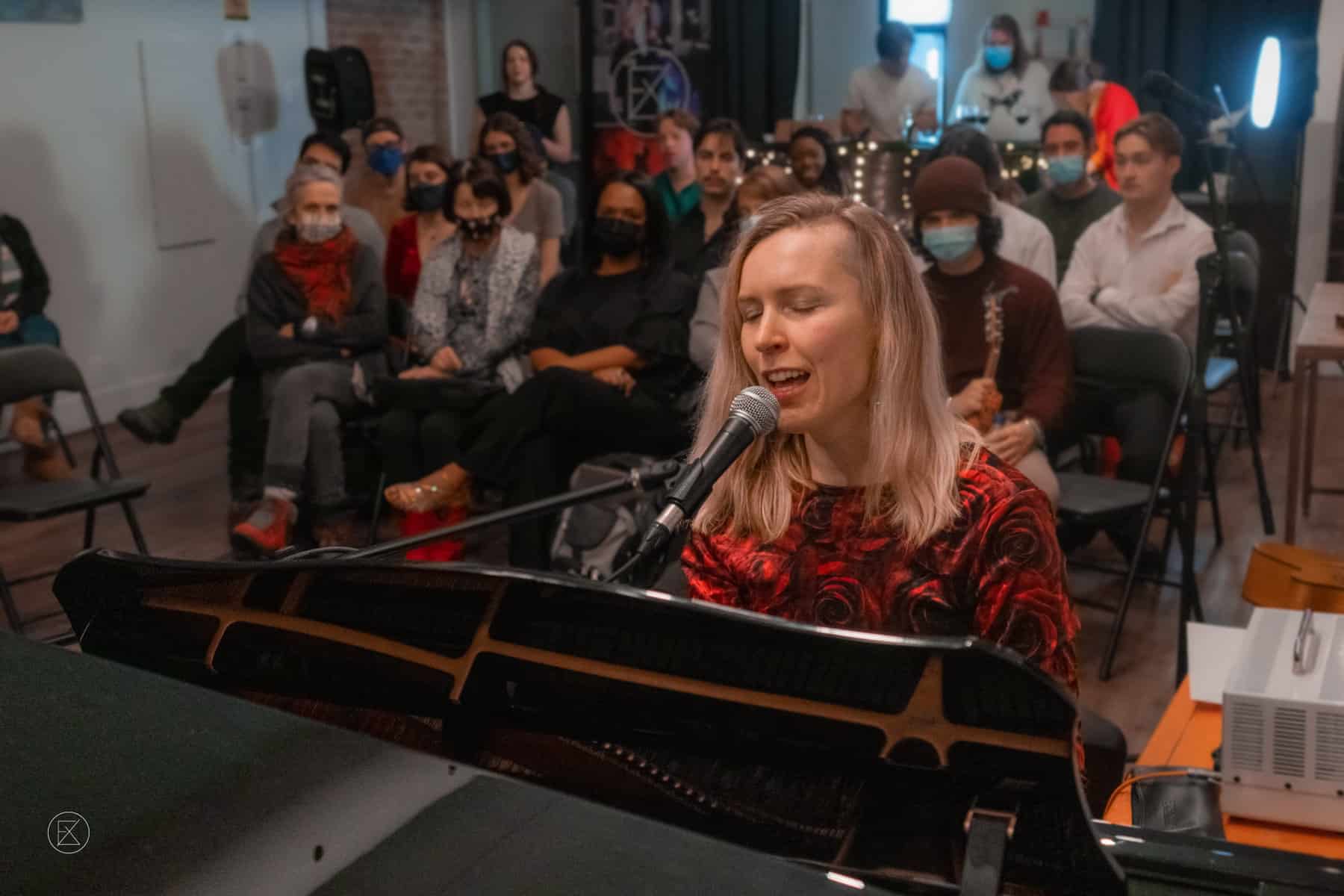
“If you are a studio, you need to have a good, professional-looking space to teach out of,” Jordanne says. She upgraded from a $1,500 piano to a $3,000 one, pays for a bigger apartment, and soundproofed her studio with carpet, panels behind large pictures and closets full of books. Jessica rents space in a church, a safe community building where parents feel comfortable sending kids, and decorates her studio with twinkly lights, diffusers and art commissioned from a colleague. Even online, students need to feel welcome.
To set up a professional teaching space:
- Invest in a good instrument; people like to sing next to nice instruments
- Soundproof what you can, and tell your landlord and neighbours you teach
- Keep your background tidy and welcoming for online lessons
- Add personal touches that make students feel safe
For a look inside the EXPRESS experience, watch the video below.
Imposter Syndrome and What Kind of Teacher You Are
New teachers, especially from classical music, often feel they have nothing to offer until they’re perfect. Jordanne’s advice is to take a breath, remember what you’ve achieved, and remember that most students are beginners. Jessica adds that part of teaching is helping students become their own teachers, so they can listen and feel without guidance between lessons.
Teach what you can sing safely
If a student wants a style you can’t do, Jordanne says don’t teach it yet: teach healthy technique, then learn the style yourself, “because you are the product for your business.” Jessica spent years learning to belt and only started fully teaching it once she was sure she wasn’t hurting herself.
Be authentically you
Jessica describes her style as bubbly; Jordanne calls hers serious and focused. Both work, as long as your teaching style is something you can maintain. “You can’t build a career on a falsity,” Jessica says. Before you start, decide:
- What kind of teacher you are, and what your personality brings to lessons
- Which styles you can teach safely today
- Which skills you’ll learn next, and who you’ll refer students to in the meantime
- How your branding will reflect who you are
Listen to the Full Episode
This guide is based on Season 1, Episode 9 of the Singers Tension Podcast, “Launching A Teaching Career.” Prefer to listen? The full 55-minute conversation is below. For practice tips, read our guide from Episode 1 on how to practice singing.
About Jessica Kos-Whicher
Jessica Kos-Whicher is a Winnipeg-born soprano, music educator and the founder and director of J. Kos-Whicher Vocal & Performing Arts. She studied with Tracy Dahl and Monica Huisman at the University of Manitoba, where she earned a Bachelor of Music and a post-baccalaureate diploma in vocal performance. Her roles include Tatiana in Eugene Onegin and Sister Rose in Dead Man Walking with NUOVA Vocal Arts, and she has been the soprano soloist in Handel’s Messiah with the Winnipeg Symphony Orchestra.
About the host
Jordanne Erichsen is a soprano, vocal coach and Alexander Technique practitioner, and the founder of EXPRESS Voice Studio. She hosts the Singers Tension Podcast, where working singers talk about technique, the body, performance and the music industry.
EXPRESS coaches like Jordanne teach private singing lessons in person in Montreal, Toronto, Vancouver, Ottawa and Mississauga, and through online singing lessons anywhere in Canada. Meet the artists who teach on our vocal coaches page.
Learn from working artists who teach. Find your EXPRESS coach, in Montreal, Toronto, Vancouver or online.
Frequently Asked Questions
How do you become a vocal coach?
To become a vocal coach, build comfortable, consistent technique in your own voice, get training in voice teaching, and start with a few students. Then decide whether you want to teach casually or build a studio, because a studio needs branding, a professional teaching space and a plan for finding students.
Do you need to play piano to be a voice teacher?
No, you don’t need to play piano to be a voice teacher. Many great teachers don’t. Learning basic chords or single notes helps you lead warm-ups, and students can practise songs with a recorded accompaniment track or a session with a pianist.
How much does it cost to brand a voice studio?
It depends on how much you do yourself. Jessica Kos-Whicher paid about $10,000 for a full agency package with a logo, brand guidelines, a website and a photo shoot. Jordanne Erichsen built her own website and spent about $400 on Instagram templates.
How do voice teachers find students?
Most voice teachers find students through word of mouth, local Facebook groups, social media and a Google Business Profile. Word of mouth drives kids’ lessons because parents talk, while adult students more often find a studio through Google search.
Should voice teachers in a studio be contractors or employees?
Jessica Kos-Whicher hires her teachers as contractors, not employees, because her studio isn’t big enough to offer benefits yet. She had a lawyer draft the contract so both the teachers and the studio are protected. Get legal advice for your own situation.
How do you deal with imposter syndrome as a new voice teacher?
Remind yourself of what you’ve achieved and that most students are beginners. If your technique is comfortable and consistent, you have something to offer. Only teach styles you can sing safely yourself, and refer students to another teacher when they need something you can’t provide.
Full Episode Transcript
This transcript of “Launching A Teaching Career” has been lightly edited for readability.
Read the full transcript
Why Jessica built a studio (00:00)
Jordanne: This is the Singers Tension Podcast, the podcast by singers, about singing, for singers. Hey, singers. Welcome to the Singers Tension Podcast. This is Jordanne Erichsen, and today I’m talking with Jessica Kos-Whicher about starting your own voice studio, or even just the transition into being a teacher: what that means, and how you can make it work for you, to give you an income if you still want to perform or if you want to make this your full-time gig. Jessica is the founder of J. Kos-Whicher Vocal & Performing Arts in Winnipeg, Manitoba, which currently employs three teachers for voice, piano and guitar and reached a total of almost 70 students after only two years. Jessica is an accomplished singer in her own right, obviously, since she created this studio based on her singing ability. She has gone on to the regionals for the Metropolitan Opera competition twice, performed lead roles with Opera NUOVA, was a finalist for the McLellan vocal competition, and has an upcoming performance with the Winnipeg Symphony Orchestra. So welcome to the podcast, Jessica.
Jessica: Hey! Thanks for having me.
Jordanne: Oh yeah, it’s my pleasure. I really wanted to have you in particular to talk about this topic, because both of us have created a voice studio on a very different path. I think a lot of singers, especially now with the pandemic, are asking how do I do that? They need tips on getting students and getting them quickly, and on the balance between being a performer and having students, and the different facets that can take up in your life in terms of time. Do you want to get really serious about social media and a brand, or do you want to just have some casual students? So I think it’s going to be really helpful to see both of our perspectives. Why don’t you start by giving a little insight into why you decided to create a studio versus just teaching casually? Because before you branded the studio, you did have some students. So why did you make that change?
Jessica: Yeah. I started teaching when I was taking vocal pedagogy, and then I had seven students, and then I had 17, and then 21, and then 27. And 27 felt like I was a success. Then I got asked to sing a role at Opera NUOVA, and I was like, oh, I could maybe be a singer and a teacher. That was really exciting to me. I started doing the audition route, and I learned a lot doing that, and it was really fun for a period of time. I had successful auditions. I think you get to a point as a singer where even on your worst day, you’re not going to sing poorly. You just might not be what they’re looking for. So I would have successful auditions and get really positive feedback. And then I got my third rejection from a company that I was very interested in. I consider myself reasonably thick-skinned, and I can process things and reframe them in a positive way, but I was really sick of having other people make the decisions about my life. So I said to my mom, listen, I’m just going to make a school where everybody gets in. I want everybody to have an opportunity to sing, and I don’t want them to feel like they can’t do it because somebody doesn’t like their dress or something like that. It was so frustrating. I still did want to pursue performance, but during those three years of auditioning I was teaching at the same time, and I was basically teaching to fund my audition trips. As you know, those trips are so expensive. I was living at home, spending very little money on rent, and spending a lot of my income on flights and audition fees and food on the road. So I just decided, yeah, I want control of my own life.
Teaching with a purpose (05:00)
Jordanne: I think it’s really nice to hear that you didn’t just go into teaching because you needed an income. A lot of singers, especially in the classical world, get pushed into a route where they’re working some type of job that they really don’t like and that isn’t related to singing, so they decide, okay, I’ll just start teaching. That’s okay if you want casual students and you explain to them, I am a performer, so things might not be regular. There’s a way to make that work. But no matter what, whether you have casual students or you create a voice studio or a music studio, you need to be passionate about teaching.
Jessica: Totally, I agree. And I felt really strongly about creating a safe space for students and an inclusive environment. I wanted to be able to use my degree. I did not spend all that money on my education to not use it. So many artists don’t even get to use what they put so much time and money into. I really wanted that for myself, but I also wanted to do it for other teachers and other artists. I love performing, and I want to be able to do it, even if it’s just small things, but it was getting to a point with that audition circuit where I was starting to resent the fact that I was even doing it, and that was quite terrifying for me as a singer.
Jordanne: Yeah, I can definitely relate to that feeling of wanting to be in control of your future. I’ve said this to you before, and I’m very open about it: I came to realize that I had an idea of what was going to make me happy as a performer, and I was so convinced that it had to be 100% performing. There was no room for anything else, because anything else was a huge failure, especially after winning so many scholarships and awards. You feel an obligation to those people to show them that you were worth those scholarships. So subconsciously, you start to develop this thought that if you do anything else, you’ve let people down, and you forget that this is my life, so maybe I should get in touch with what actually makes me happy. It was my 25th birthday, I think. I always go to a cabin that’s in my family, and I was out there by myself sitting on the dock. I had found a book in one of those little tree-fort book libraries on my way home from the gym, about a type of psychology where you dissect your dreams, which is so hippie-dippie, but I was really into it. I kept having this dream and this anxiety, and the book said that whatever your dream is, you have to play every role. So I went through this process and realized that I was not happy trying to put all of my eggs in one basket and just be a performer. But I also didn’t want to teach mostly kids. For me, having 40 kid students is not as rewarding as working with adults. So I realized that I wanted to create a studio that did have some kids, but mostly focused on adults and professionals and people who really wanted to elevate their artistry. We’ll get into the branding a bit later, but I have a huge passion for helping people sing without pain, because I had such a difficult journey with singing. By the time I finished my undergrad, I couldn’t sing for more than 15 minutes without extreme pain through my throat and my jaw. Thanks to some amazing teachers after my undergrad, I really undid that, and then Alexander Technique has been a whole other world that took it to the next level. But it was such a journey, and I remember so much frustration. That’s where my passion comes from. So you can find different reasons to be a teacher, but there has to be a reason beyond “I just want to use my degree and make money.”
Jessica: Totally, I totally agree.
Voice studio or arts school? (09:30)
Jordanne: A question we’re going to answer throughout this episode is: what is the difference between having a home studio as a casual teacher versus an arts school or vocal school? There’s so much difference in terms of capacity, workload, your media and the image you’re going to create. I would classify your school now as more of an arts school, because you have piano and guitar, and mine is mostly a vocal school. We do include piano. I’m not the only teacher who teaches piano; Mike does too, and he’s a great pianist. But the other two are just voice, and all of our social media really focuses on voice, voice, voice. So what made you decide to open it to other instruments?
Jessica: Originally I was just voice. Then I was getting so many inquiries and so much word of mouth that I just couldn’t. I’m only one person. I had a parent say to me once, could you teach piano? And while I can play piano reasonably well for students, I would never accompany them in a professional setting. That would be so embarrassing for me. So I knew I was going to need a piano teacher eventually. I was also getting so many voice inquiries that I needed help. But part of the reason I thought I could really do this was that if I was feeling like I had no control of my life, then surely other artists felt the same way. I wanted to be able to offer different things to the community and also expand students’ creative minds.
Do you need to play piano? (11:00)
Jordanne: How should people who want to be singing teachers but don’t play piano go about that? Is that possible? Because I do play the piano, but two of the teachers who work for me don’t, and they always express a little bit of imposter syndrome, because they feel they can’t accompany their students. And not all of the teachers I’ve had could play piano. So what is your take on that?
Jessica: I think everybody has a different skill set. If you look at Karen and me: Karen Santos is an amazing soprano who works with my studio. She’s also a really good friend of mine, and we work super well in tandem. We’re a great team. She does not play piano, and she’s an amazing teacher. I think it can be beneficial sometimes to not have the piano, because then the student has to rely on a new set of skills, like their ear. Listening to a track is important, but it’s equally important to listen to yourself and figure out how things feel: I’m out of tune and I can hear that and feel that, versus I’m not aligning with what you’re playing. As a teacher this is really difficult to do, but get your ego out of it. If a student needs something you know you can’t provide, send them to someone who can, or offer a suggestion. I had a student I worked with for about a year and a half, and then he got to a point where he said, I want to work on rock music. And I said, you know what? I can’t really do the scream thing, but Ian can, so I’m going to send you to him. He still came back for lessons every now and again to work on technique. But if I had said, oh, I don’t want to send him to another person, I’d just be doing him a disservice. It’s not about you. Check your ego at the door, people.
Jordanne: Yeah, you don’t need to prove yourself. And just as a side note, not every student is going to give you the feeling of, yes, I’m accomplishing something. I’ve had students where every lesson there’s a lot of push and pull, and they need a lot of explanation, and you can tell the way you’re explaining is not clicking with them and not giving them what they want. They’re on their own journey. With voice in particular, everyone needs permission to be on a very unique journey, and you may not be the right fit. The first time that happens, it does sting a little, because in your heart your intention is, I want to help them. But you have to let them be free. You can’t hold on to them. I had some teachers who really wanted to hold on to me, and I was like, I’m stuck with you. That doesn’t devalue the things you’ve given me, but I’m stuck right now, so I need to look for something else. And I still go back to those teachers myself, but I was stuck.
Jessica: I think that’s important. That’s a good lesson just in general in life. You can’t expect to get everything you need out of life from one avenue.
Jordanne: But if you as a teacher do want to be able to lead someone through a warm-up, it’s not so difficult to learn how to do chording on the piano. That would be my suggestion. Don’t feel like you need to be able to play their repertoire, but being able to give chords to take them through a warm-up is a great skill. And as a student, if you’re looking for a teacher who plays piano, I wouldn’t prioritize it, because an option your teacher should and may suggest is that you work with them on the technique of the song, and then they bring in a piano player for a lesson, which you as a student would pay for, to practice pairing with the music. Or you can pay a small amount of money to have someone record the accompaniment, so you have a practice track to sing to in the lesson. So there are ways around that.
Jessica: Oh, 100%. That’s a great point. I totally agree. Chording could even be as basic as, I know a scale, and we’ll go up it one note at a time. You can just play the note. There are times when I’m just playing the note; I’m not even doing the chords.
Jordanne: Yeah, especially with beginner singers. The warm-up is usually very basic. They can’t hear beyond the one pitch.
Jessica: Yes, exactly.
Branding: the agency route (15:40)
Jordanne: Now let’s shift to the thing we’ve been alluding to, which is branding. So you know that you want to teach in some capacity, because you have a motivation beyond money, and you’ve decided whether you want to be a casual home studio or more of a school. If you’re just a home studio, I’ll briefly say that you can still promote yourself as a teacher on social media. I would focus more on personal photos of you as a singer and a performer, and on what you’re doing as a performer. Whereas if you want to be a studio, we need to get into branding. So tell us how you went about that, Jessica, and then mine’s very different, so we’ll share.
Jessica: I was trying to design my own logo. What a horrific mistake, trying to design a logo with absolutely no knowledge of graphic design. I was nannying at the time for a wonderful family, and the mom is the director of a business here called 26 Projects. I knew she was a photographer, and I thought they did marketing, so I asked her, hey, this is maybe a weird question, but do you guys design logos? And she said, that’s not a weird question, and yes we do, but it wouldn’t be just a logo. If you need a logo, you need a full brand guideline, basically. And I was like, yeah, sure, whatever that means, I’m in. So I went down to their studio and had a meeting with them, and I thought, wow, this is going to be so cool. Then I told my mom, it’s going to be X amount of dollars. I was expecting it to be a lot, because I had no idea, and I knew it wasn’t going to be $100. Okay, people: if you’re looking to brand your business, that’s a lot of hours that company is going to be putting in. It’s so many brains on one project, and they’re designing things like the J in my logo, which is a hand-designed concept. It’s kind of iconic how they came up with it. They figured out my name for me too. That was several emails back and forth. We looked at musical terms, we looked at different names, and I kept saying, I don’t know, nothing is jumping out. Then I got my logo, and they came up with custom colours for my brand. They picked fonts based on certain criteria. I got a letterhead, business cards and little flyers, which I still have because I printed a million of them, in three different designs. I got a photo shoot. They did my website, and they did, I think, five or ten Instagram posts to start. Later that year I ended up winning a contest they ran, and I was able to get another photo shoot and a campaign, so when I was advertising for a summer camp before the pandemic, I had those photos as well.
Jordanne: If you don’t mind sharing, I think it’s important for people to know what you got in your package and what it cost you.
Jessica: It was about ten thousand dollars.
Jordanne: And you mentioned to me once that you had this money saved up beforehand.
Jessica: I had this money in a savings account. At one point I thought it was going to be for a house, and then I talked to my mom, and she said, listen, I think that’s going to be the best money you’ve ever spent. And it was the best money I have ever spent, because it makes running a cohesive business way easier. This is the font I write all my emails in. This is the font for the posts. This is the colour for the background of everything. This is it, people. It makes it really easy. And if I ever wanted to rebrand, I have something to go off of.
Branding: the DIY route (21:00)
Jordanne: I think that makes a lot of sense for you and how you were feeling, because it is overwhelming, all the things you need, and if you don’t know how to do any of it, you have to learn. The nice thing about making that monetary investment at the beginning is, yes, it’s a little scary, but as you said, you have the whole package, so you’re ready to go. Everything is done, so you can set up your schedule for social media and whatever, and you don’t need to worry about it. That’s the way you went about it. My route was very, very different. I did not invest $10,000. It was more organic, because of the job I had when I first moved to Montreal. I had an awful job, the thing no one ever wants to do: I was cold calling for a website company. I hated it so much, Jessica. I’ve never had so much anxiety. My family teased me about being the person nobody wants to get the call from. I did this for maybe three months before my soul fell out of my body, and then I told them I was quitting. They really liked me, so they moved me over to the account management side, which was brilliant. Everything happens for a reason, because I learned all about Google My Business pages, Google AdWords and how to get on Google. I was also friends with the person designing the websites, and he would throw out offhand comments about what he was working on, so I got little snippets of knowledge. So when I decided to do the studio, I made the website myself. This took hours. I also had to consider who I was branding to, and mine was adults, so I didn’t use bright colours. If you go on Express Voice Studio, it’s darker colours and more graffiti-inspired. I came up with the name, which I was really happy with, and my boyfriend at the time was a graphic designer and a graffiti artist, so I asked him to do a graffiti kind of design for the logo. So it kind of worked out; I kind of cheated. He did the image that is now the logo, we did three different versions, and I’m really happy with it. I also knew how to do Google AdWords, so I created a Google My Business page and got on Google. Now if you search any keyword in English in Montreal, we’re on the first page at least once, sometimes twice. French keywords we’re still working on. When you’re not bilingual, you pick away at it as you can. I also taught myself Adobe Illustrator, Adobe Audition and Adobe Premiere Pro. I spent the time to learn how to do everything, and it’s still a huge learning process, now with the podcast and the YouTube videos. There’s so much to learn, so you just have to dive in, know that this is going to be a long-term project, and try to make every single thing better than the one before. The only thing I did spend money on, after I came up with the website and everything, was Instagram templates that fit with it. I hired someone, and it cost me about $400 for, I think, five templates. We went back and forth as well. The original thing he sent me was very soft, totally not the artistic, in-your-face thing I wanted, so I had to buck up and basically say, I don’t like that at all, I’m sorry that you spent time on it.
Jessica: Right, and you feel really bad. You’re like, they spent time on this. You feel bad, but at the same time…
Jordanne: You’re paying them.
Jessica: Yes.
Jordanne: And if you’re not a graphic designer, you can draw something and say, kind of like this, but better. So I sent him a ton of pop art images that I really liked and said, I want to go in this direction. The next version was totally different, and then I asked, can we just have some different colours? Within a week of him working on it, it was done. Now, because I know how to use Illustrator, I can go in and change the colours or the format as much as I want. Any time I have a campaign, like Valentine’s Day gift cards or Christmas, I’ll create those based on the templates, or sometimes something completely different using free software like Canva or stock images. Illustrator you have to pay for, but it’s not that much: it’s about 30 USD a month for the whole Adobe suite. It cost me a lot less, but it took a lot longer, and you have to learn how to do everything. So those are two different options, depending on what you want to do.
Six jobs and the sacrifice (25:50)
Jessica: Depending on what you already know and what you want to put the time into. I was like, I don’t have the time to do this. Not to suggest you have buckets of time either, but I think it also depends on how many students you already have and what other jobs you’re already doing, because as artists starting out, you probably don’t have just one job. Plus you’re trying to practice, plus you’re trying to do all the other things you need to do, like shave your legs, you know?
Jordanne: Brilliant segue. I think it’s important to put a voice to this. I had six jobs at one point. When I decided to make this studio happen, I was cantoring at two different churches. I had a nine-to-five job at a startup called Career Up. It was a good job, but it was a nine-to-five. I was also editing university papers for an online company, I was teaching some students, and I was doing something else. I can’t even remember all the jobs, but I remember counting six, and I had literally no time, absolutely none. I was doing auditions during this period as well. So I made a huge sacrifice in terms of wanting to perform. I said, I don’t have the time to even sing right now, and I never will if I have a nine-to-five, so I need to sacrifice maybe a couple of years of my life building the studio so that on the back end I have more freedom of time. Now I’m not where I thought I would be in terms of all the auditions I’d want to do, but I have a studio that is my full-time job. I don’t have six jobs anymore, and I have the freedom I wanted. So there was a sacrifice, and I think people need to know that.
Jessica: I think we’re both lucky. We get to go to work and it doesn’t really ever feel like, oh God, I have to go to work. That is something I wanted for my life. As a teacher, I never wanted students to feel like their teacher doesn’t even like doing what they do, which is why I brought on a team of teachers who are all different but all equally passionate about what they’re doing. They’re passionate about performance and about being creative, and that’s what I wanted. I wanted kids to see passion. But yeah, there was a time when I was working at an Orangetheory, doing auditions, nannying, and teaching, and I had about 34 students at that point. It was crazy. It was insane. But I don’t think I ever had six jobs. That’s excessive. I don’t even know how you did it, girl.
Jordanne: I don’t know. I question things in my life.
How to get students (28:40)
Jordanne: So you mentioned that a lot of your students come from word of mouth. Are you doing any kind of advertising outside of that, or is it just people who find you from the website? How are you getting students?
Jessica: I started off getting students from word of mouth, and now I’m on all the Facebook groups for the area you live in. I still get a lot of word of mouth. I’m very, very fortunate that we have a really good rapport with almost every family we’ve ever dealt with. When I first started, I was taking an adult dance class at a really amazing studio here in the city, and I asked, could I put up an ad or a poster? Which I didn’t even have; it was like a piece of loose-leaf. It was really bad, but I was very green to the teaching life. And I asked, can you please tell people about me when they’re registering? And she said yes. So many of my students came from that. Another part of the package I got: they set up G Suite for me. I don’t even know what it does, but apparently I need it. They asked, can we set this up for you? And I said, sure, do whatever you think I need. They connected it to the website, so now I get inquiries through my website, and I’ll sometimes post in the Facebook groups I’m part of, like, hey, don’t forget that we do this.
Jordanne: Word of mouth is fantastic. When you’re dealing with kids and teenagers as students, word of mouth is your bread and butter, because parents talk. I basically had one child student at the beginning, and all of my other child students came by word of mouth except for one person. They all know each other; they all go to the same school. When you’re dealing with adults, it’s different, because lots of times people come in for lessons because they want to be better at karaoke, or they’re already an artist. I’ve had a couple of rappers and a pop artist who weren’t referred to me. They found me, and they’re not really referring me to other people unless it specifically comes up in conversation, because it’s more private and more personal. You’re not going to say, oh, you should put Stacy and Mike in singing lessons too. So I would say 90% of my new business comes from the work I’ve done to be on the first page of Google. Your Google My Business page is the thing that comes up on the side when you search, say, pizza near me, and Bob’s Pizza comes up with the hours it’s open and so on. And if someone ever calls you saying they’ll set it up for $400, it’s a scam. Hang up the phone, first of all, because you set it up for free.
Jessica: Right, exactly.
Jordanne: I still get those calls. They say, you don’t have one, and I say, yes I do, I set it up, thank you. You do need it to show up on Google Maps. It’s really important. Maybe I’ll do a whole podcast episode on all the ways you can get your business on the first page of Google, but that is really how I get my students. I tried Kijiji and put some money into it, and I would say it’s not worth it, personally. With Google AdWords, you pay per click for someone clicking on your ad to come to your website, and you set a monthly limit. I do think that is worth it. It also reinforces to Google that you’re a valid business, so it can help you get onto the first page of Google if you’re doing a lot of other things in tandem. Social media, surprisingly and not surprisingly, brings in messages all the time through Instagram and Facebook asking about lessons. And join the Facebook groups in your area. I’m part of a Musicians in Toronto group and a Musicians in Montreal group, and any time we have a post on Facebook, I share it in those groups, within reason. If it’s a little fluffy post, I won’t, but if it’s a new podcast episode or something valuable to artists in the area, you post it. So, very different ways. I don’t think you need to spend hundreds of dollars on advertising. When I first started, I had a budget of $60 a month for Google AdWords, and now that budget is $100. But I don’t think it’s essential. I do need to do another podcast episode on everything I did to rank on Google, because I did it myself, and I get phone calls from people I went to music school with and haven’t spoken to in years, saying, hey, I saw what you’re doing, can you give me some advice? We’ll sit down and do an hour or two on all the things I think they need to do and put time into. So if you’re listening to this and want some advice, please reach out and contact me. That’s a service I offer. There’s a lot to know, but please don’t be overwhelmed by it, because it is attainable.
Hiring teachers: contractors or employees? (34:10)
Jordanne: So segueing from that: you have a studio, things are going well, maybe you hit the 20-student mark and you’re still getting inquiries. Now you have to make the choice: do I just have a waiting list because I want it to be me, myself and I, or do I want to hire other teachers? When I decided to hire other teachers, it was primarily because I had worked for three different music studios in my life, and all of them took a 40 to 50% cut, and I couldn’t understand why they were taking that much. The most recent studio I worked for in Montreal said people won’t pay that much for you as a teacher. That’s not true. First of all, it’s not true. If the value is there, you set what you deserve. I wanted to give teachers the opportunity to choose their rate and not have a 50% cut. So all the teachers who work for me pay out very, very little, and that goes right back into advertising for the studio. I don’t make a massive profit off of it, but it pays for the advertising. So why did you go about hiring more teachers? Did you find that you just had that influx? And you have a distinction between employees and contractors that maybe you could talk about.
Jessica: Okay, so I decided to seek out other teachers because I was getting inquiries, and I could have taught all those students, but I would have been teaching until 9:30 p.m. every night and teaching an eight-hour day on Saturday. Where is your life? Where is your time to work out, or just watch Friends, or have a conversation with your mom on the phone? There was no time. Before Karen came on board, I had another colleague named Chelsea who worked with me for a period of time, but then she had to move. And right when she was moving, Karen said, I’m going to Winnipeg, and I said, this is amazing. Then Renata, who is the music director at the church I operate the studio out of, and I were passing in the hallway one day, and she said, hey, maybe we should talk. This was something I’d been thinking about, because I was getting inquiries, but I didn’t want to go to someone and say, hey, I have one student for you. I wanted to know I’d have at least three students, so they weren’t coming in for one half-hour lesson. That just wouldn’t feel fair or worth it for a teacher. So I wanted to make sure I had enough inquiries for piano, and I decided yes, I should do that. But it wasn’t big enough to say, okay, we can be employees and I can offer benefits and all these things. I would love to offer benefits to my contractors at some point. That’s the dream: give opportunity to colleagues and develop a team of people the community trusts for all these services. But I felt it was important to protect them and myself by identifying them as contractors, not employees. So I went to a lawyer and said, help me figure out their contract. Now I have a document where I can change the date and the name, and rewrite some things if I want. I know what it says, but it’s all legal jargon, and it’s crazy. I went to a lawyer because I felt it was important to have everybody protected, not just me. Them as well, so if I do something they feel isn’t fair, they can say, this is not what my contract says.
Your teaching space is your image (38:40)
Jordanne: I think that’s especially important for you, because you’re renting a commercial space. It’s a church, but it’s a space for your studio, and you have people coming in and out, so it was critical for you to do that. This is something you and I also do very differently: I don’t rent a commercial space. My studio is in my apartment, and it’s its own space. It’s very professional looking, and the requirement for all of the other teachers is that they have a professional-looking space to teach out of. So I don’t need to take a cut from them to compensate for a space to teach in, and I don’t handle all of the invoicing admin that you do. Once a student comes in and talks to me about their goals and what they want, I have a conversation with them and direct them to the teacher I think suits them best. Then it becomes that teacher’s responsibility. They can invoice them however they want; that’s all between them. At the end of the month, they pay me out depending on how many lessons they taught to students from me that month. So I probably take a much smaller cut than you do, but my workload is also much more minimal. However, I’m extremely busy with the podcast, creating online content and advertising the business. So it becomes a question of how much work you want to put into different areas. When you have a commercial space, your priorities are different and you do need to take a bigger cut. Obviously, they’re teaching out of a space you’re paying for. That’s a massive cost.
Jessica: Massive. It’s definitely not small. I’m lucky that it’s in a church, because it’s less, but I also chose it because I needed a community space. I needed it to be a big space where people are comfortable to just let their kids walk in. Not somewhere in downtown Winnipeg, going into a building that would be scary for a lot of little ones who are there for a lesson to sing Frozen. I wanted it to feel like a safe community building. And it just so happened that when I was selling a house about five years ago, I called that church and said, listen, I just bought a grand piano and I need a space. What have you got?
Jordanne: You need to understand that. If you’re teaching on a keyboard in a grungy little space in your tiny apartment, I understand that you’re an artist on a budget, but your image is important. If you’re doing the casual thing, where you take students because they know about your work as an artist, that’s fine, because they’ll see that this person really is living the artist’s life. But if you’re a studio, you need a good, professional-looking space to teach out of, and be prepared to spend that money. The first piano I bought was $1,500, and the next year I upgraded to a $3,000 piano, and it makes so much of a difference in the enjoyment of the sound. People like to sing next to nice instruments. I also spend more on rent for a bigger apartment than other people would. And if you’re looking for an apartment, tell the landlord that you’re a music teacher. My current landlord asked, have people ever complained? And I said no, because I also spent money to soundproof the apartment. I put down a carpet, I put soundproofing behind the large pictures in the room, I filled all the closets with books. You do as much as you can. You also tell your neighbours that you’re teaching, and ask, do you have a weird schedule? Are you a nurse? I need to know about that. Have some respect for sound. But you need a nice-looking space.
Jessica: It makes such a difference. It does. Obviously it’s very different when we’re all teaching in our apartments, but part of the reason I care is that, as soon as I moved, I said, I’ve got to get the space ready, because I have students on Monday. They all knew I was moving, but if I ever move my computer around, I don’t want them to see craziness everywhere. I want them to see my white couches, my bold rug and my twinkly lights, because it makes people feel welcomed into the space. Even in an online setting, they need to feel safe. In my studio I have diffusers, twinkly lights, and art that I commissioned from Karen to paint for my studio. People say, that’s a cool painting, and I say, Karen next door did it. I just think it’s so important. Like you say, your image is important. I think we’re all struggling, pandemic-wise. Next weekend I have everything booked, because everything is starting to open here: we’re getting the hair, the nails, the lashes, we’re doing it all.
Imposter syndrome (44:30)
Jordanne: I love it. If you decide, I want to do this teaching thing, I want to make a studio or I want to teach as an individual, you’re going to have a bit of imposter syndrome, especially if you come from classical music, where everything is either perfect or it’s wrong. You feel like you couldn’t possibly have anything to offer until you have an international career and you’re perfect. That’s just something you have to get over. There’s this idea of putting enough value into what you charge for your lesson, so you do need to understand your worth as a teacher and the value you’re giving in order to set that price. But when those moments of imposter syndrome come, take a breath and remind yourself of the things you’ve achieved. Know that the people coming to you as a teacher are usually beginners, and you have so much experience and education behind you that you take for granted. Even though you may not have everything figured out with your voice, if you’ve brought it to a place where you have comfortable, consistent technique, you have something to offer your students.
Jessica: Yeah, that can definitely be a challenge when you’re working with the full gamut of students. We’ve got students who say, no, I only want to sing pop. No, I want to sing Disney. No, I want to sing musical theatre. No, I think I want to sing classical. And there are definitely students who are well suited to every genre. I’m not a belter. I have the knowledge I’ve gathered from YouTube videos and developed over the last five years trying to figure out my own belt technique. At first I said, I don’t really teach that, because I don’t know it. Then I said, listen, I’ve got students who need to know about it, so I need to know about it. I do read and study and figure it out, but a lot of my practice is quite hands-on. I walk around my apartment speaking in weird Sesame Street voices and doing weird things to find where it’s resonating, so that when I go to a student, I can say, it’s kind of like this voice, but with a high soft palate. Even as a teacher, you have to teach your students to become their own teachers in the lesson. Sometimes it’s guided practice, but part of what they’re learning in the lesson is how to listen and feel without guidance, because we’re not always going to be there saying, no, that doesn’t sound good, you need to fix it. They need to be their own guide. That’s part of being a teacher.
What kind of teacher are you? (48:00)
Jordanne: Yeah, and you made a comment last time we spoke that I thought was so on point, about deciding what kind of teacher you want to be. You and I have very different vibes. You are energy and bubblegum, the Powerpuff Girls incarnate, and I’m so serious. I’m like, this next hour of your life is going to be so mentally fatiguing. My students are so done by the end of the hour, but in a great way. I really do come at it like guided practice: I’m teaching you how to work on your body and be stubborn and patient with yourself at the same time. We’ll be doing an exercise, and so many times I’ve stopped them and said, you’re not thinking the right thought. I stop them so much. And then they get to a point where they start to do it and say, no, that’s wrong, wait. And I say, did you just tell yourself to wait? And they say yeah, and I say, you’re hearing me inside your head.
Jessica: It is really great to watch that journey for a student. I have a student this year who is just so brilliant. He’s a male student, which makes me really excited as a teacher, and he’s started coming to lessons saying, I did the warm-up before my lesson, so I’m ready to go. Last week I didn’t do it and I felt like it wasn’t working as well, but now I feel really good because I warmed up before my lesson. And I’m like, who are you?
Jordanne: That’s such great content for another podcast episode I have to do, on what a lesson should actually look like if you have a good teacher. I really feel like it’s a conversation: me offering a suggestion and asking, what does that feel like? What do you like about it? How do you perceive that? Okay, let’s build on that. You as the teacher are not God. So don’t keep saying things the same way over and over again, and you should probably check in with how your student is processing music mentally and how they relate to it. I’ll just have to make another podcast, I’m sorry. I have so many opinions on it, because I’ve had so many bad experiences with teachers. As I said, those four years of my undergrad made me a really bad singer, and I had to undo all of it.
Jessica: Such a journey.
Jordanne: Such a journey. But my point is: decide what kind of teacher you want to be. Your personality comes into it. Then make sure that’s represented in your branding. And when you feel like an imposter, just remember we’re all learning all the time. Oh, but I did want to say my opinion on what to do if a student wants to know how to do something and you don’t know how to do it: you don’t teach it. If you have great technique and all you sing is opera, then you say, I don’t know how to belt, but I can teach you how to sing, use your air and not hurt yourself. Then you, as the teacher, should go out and figure out how to belt, whether you can do it, and start singing that repertoire, because you are the product for your business. If all you know how to do is one thing, that’s what you teach. A guitar player isn’t going to say, well, all my students now want to play piano, so I’ll watch YouTube and then teach piano.
Jessica: Oh yeah, no. Again, it’s taken me a full decade to learn how to sing pop reasonably well, or to feel good about singing pop and belting, and I didn’t fully start teaching belt until last year, when I was confident I wasn’t hurting myself while doing it. So I’m confident I can teach you to be safe while doing it too. And again, Karen and I collaborate often on technique and how to do what we’re doing. But yeah, I think it’s so important, when you’re figuring out what kind of teacher you want to be, to be authentic.
Jordanne: You got it. When you’re figuring out the kind of teacher you are or want to be, because who you are and who you want to be may be different, it has to be something you can maintain, obviously. Which is why I say you need to be authentically you.
Jessica: Yeah, that’s a great point. If you decide, okay, singing teachers have to be bubbly and effervescent, and that’s not you, you can’t build a career on a falsity.
Wrapping up (52:50)
Jordanne: Well, that is an hour and a half’s worth of amazing information, I feel like. But there’s so much more we could talk about, because this has already been a two- or three-year journey for us. I’m really grateful that our journeys have been so different, because I hope it can help people. If you want more guidance, as I mentioned earlier in the episode, please feel free to reach out. I’ve helped people through this before, and I love to do it. And if anyone wants to pick your brain about how you found someone to do your branding, the lawyer and everything, reach out to Jessica. I’ll put the details below.
Jessica: I’m always game for a conversation. I think it’s important to always be learning, always conversing and always on the journey you’re on.
Jordanne: Totally, totally agree. Thanks so much, Jessica. Such a pleasure.
Jessica: Thanks so much for having me.
Sources
- Singers Tension Podcast, “Launching A Teaching Career” with Jessica Kos-Whicher, Season 1, Episode 9, February 2021
- Jessica Kos-Whicher, About, November 2026
- NUOVA Vocal Arts, “The Creative Energy Bubbling Inside of You” by Jessica Kos-Whicher, May 2023
- Classic 107, WMC McLellan finalist soprano Jessica Kos-Whicher, April 2018
- EXPRESS Voice Studio, How It Works, November 2026